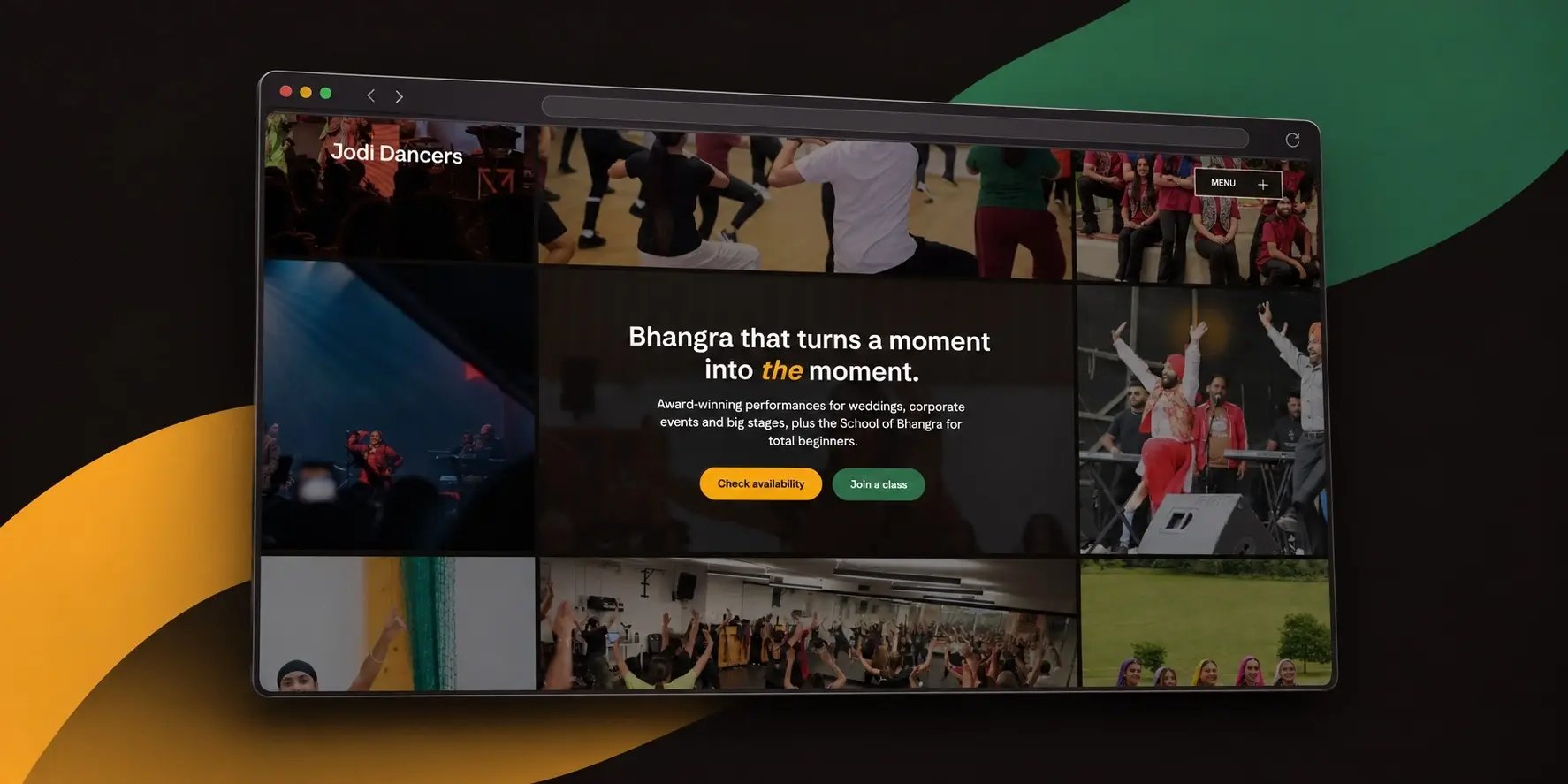
Jodi Dancers are UK Bhangra Awards winners who have performed live on BBC Midlands Today. Their website did not show it. We gave them a brand foundation, a keyword strategy built on real search data, a new design and a HubSpot website that is measured from the first visit.
At a glance
- Client: Jodi Dancers
- Sector: Live entertainment, dance classes and workshops
- Location: West Midlands, performing across the UK and internationally
- Services: Brand foundation and strategy, competitor and market research, keyword and AI search strategy, user journey mapping, UX and UI design in Figma, WordPress to HubSpot migration, HubSpot CMS build, analytics and measurement set-up
- Platform and tools: HubSpot CMS, Figma, Google Tag Manager, Google Analytics 4, Microsoft Clarity
- Launched: October 2026
Early signals
First week after launch, 29 October to 5 November 2026.
- Enquiries for performances and classes started arriving through the new enquiry form in the first week.
- Position 5 on Google UK for "bhangra dancers", searched around 1,900 times a month, held through the migration.
- Page one on Google for "bhangra classes" and "bhangra classes in Birmingham".
- 45 clicks from Google search in the first six days, at an average position of around 5.
- 57% of visits engaged with the site in its first eight days.
The starting point
Jodi Dancers had used the same WordPress website since the group's early years. It was light on detail and not organised around what they sell. News and testimonials had not been updated in years, class prices differed from page to page, and some details no longer matched the record.
The business had outgrown it. Jodi Dancers run two engines under one name: performances for weddings, corporate events, festivals and media, and the School of Bhangra, weekly classes across the West Midlands. The founders wanted a premium presence that could stand in front of festival programmers, film and TV producers and corporate buyers, not just past customers.
Search visibility was also falling. Estimated monthly search traffic dropped from around 450 visits early in 2026 to under 20 by October.
Phase 1: a brand foundation built on evidence
We started with a discovery questionnaire, then built a brand foundation of 15 documents that now govern everything the brand says.
- Positioning, value proposition and messaging. What Jodi Dancers stand for, what each audience gets, and the pillars every page is written from.
- Personas and need-states. The couple planning a wedding, the corporate organiser, the school, the beginner nervous about a first class, and what each needs to see before they enquire.
- Competitor and market research. Evidence-based competitor sets for the local class catchment and the national performance market, including how competitors present and price their services.
- Customer journey map. Separate journeys for performances and classes, with the touchpoints, content and measures for each.
- Claims ledger. Every public fact, from award years to class times, checked against a source. Anything that could not be verified stayed off the site.
- Tone of voice, guardrails, KPI framework and a 90-day activation plan.
Phase 2: keyword research that changed the site
The old site's classes page was called School of Bhangra. The data showed almost nobody searches for that. They search "bhangra classes near me", 880 times a month, with almost no competition. So the page became Bhangra Classes, written around the questions beginners actually ask: do I need experience, is it a workout, who is each class for.
The research reshaped the rest of the site too.
- Bookings. The organic market for hiring bhangra dancers is small, around 130 searches a month, and page one belongs to agencies. Bookings come through the local map results and referrals, so the plan prioritised the Google Business Profile alongside the website.
- Corporate. Corporate demand sits in team-building language, not bhangra language. "corporate team building activities" gets 720 searches a month at a difficulty of 12, so the corporate workshops page makes the case for a cultural workshop as team building.
- Choreography. Framed around "wedding dance lessons", 590 searches a month, rather than bhangra-specific terms almost nobody uses.
- Existing rankings. The homepage's position 5 for "bhangra dancers" was protected through the rebuild.
For AI search, every service page answers real questions in plain language, and the site carries structured data describing the business, the dance group and its FAQs. Search engines and AI assistants can read exactly who Jodi Dancers are and what they offer.
Phase 3: user journeys and design in Figma
Visitors choose at the first click: book a performance (weddings, corporate and wellbeing workshops, schools and SEND workshops, choreography) or join a class. Each route was mapped to its personas, then designed in Figma and taken through QA rounds before any build.
Proof sits where decisions are made. Award wins, the BBC appearance and community work with hospices and children's charities appear next to the enquiry points, not on a page nobody visits.
Phase 4: WordPress to HubSpot migration and build
We rebuilt the site on HubSpot CMS from a set of reusable page templates, so new services, workshops and stories can be added without a developer. Every enquiry now lands in HubSpot's CRM with its source, instead of an inbox.
Phase 5: measurement from day one
Google Tag Manager and Google Analytics 4 track visits and form events, enquiries end on a thank-you page that fires conversion tracking, and HubSpot records where every contact came from. Microsoft Clarity shows how real visitors move through each page, so improvements are made on evidence, not opinion.
What comes next
Enquiries are tracked by route, performance or class, so we can see which side of the business the website is growing. We will update this case study with 90-day results.
Is your website holding your business back?
Our free website conversion audit shows what stops visitors calling, booking or enquiring, with a prioritised plan to fix it.